
Introducing The Regionicity Report
Why Regional Economies Need a Regenerative Lens
The industrial revolution made centralizing everything seem like a foolproof path toward prosperity. Get good at doing one thing really well. Finance it. Scale it. Produce for the world to purchase. Pay off your debt. Repeat.
Mass production, specialization, global supply chains, and economies of scale allowed businesses to make more things for less money and move them farther than previous generations could have imagined. Wealth provided its own form of resilience. Money can be stored in a bank account. It does not go rancid, oxidize, spill, get moldy, or get eaten by wild animals. When something went wrong somewhere, we could usually buy what we needed from somewhere else.
What could go wrong?
Apparently, quite a bit.
The disruptions surrounding 2020 provide an uncomfortable reminder that wealth and efficiency are not the same thing as resilience. When grocery shelves emptied. Toilet paper became strangely valuable. International supply chains stalled. Wildfires, social unrest, labor disruptions, and a global pandemic arrived at roughly the same moment.
Systems that had looked nearly indestructible suddenly looked a lot more fragile. We have not been quite the same since.
The lesson is not that global trade, technology, or large companies are inherently bad. They have created enormous benefits. The question is whether we have become so focused on efficiency and scale that we have neglected the productive capacity of the places where we actually live.
· Can a region feed some of its people?
· Can it educate them?
· Can people find meaningful work there?
· Can small businesses start and survive?
· Can communities respond when larger systems are disrupted?
· And are we maintaining the land, water, people, knowledge, and institutions that make all of this possible?
Those questions are where The Regionicity Report begins.
2020 Was a Systems Test
To quote the legendary boxer, Mike Tyson, “Everybody’s got a plan until somebody punches you in the mouth.” Resilience is easy to talk about when everything is working. It becomes much more interesting when things stop working. The disruptions of recent years have made subjects that once belonged primarily to academic papers, environmental conferences, and government planning meetings part of everyday conversation:
· Soil health.
· Regional food systems.
· Supply-chain resilience.
· Precision agriculture.
· Workforce shortages.
· Artificial intelligence.
· Climate adaptation.
· Local manufacturing.
· AI-proof workforce and the trades.
· The triple bottom line.
These topics are moving from labs, think tanks and board rooms into classrooms, coffee shops and pubs.
Agriculture provides an especially useful place to begin thinking about these systems because food connects nearly everything: land, water, climate, labor, business, transportation, culture, health, hospitality, and community.
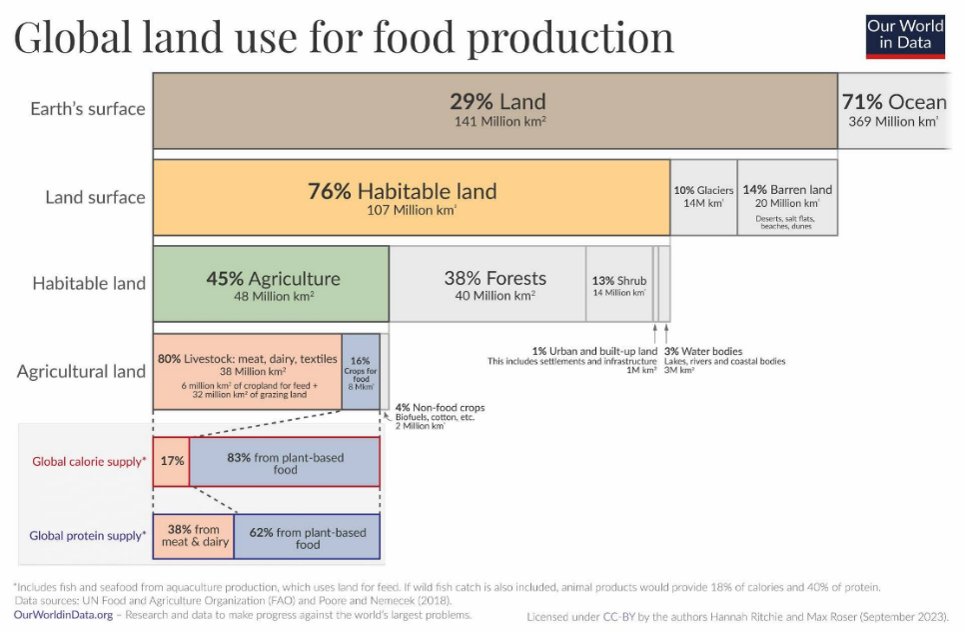
Figure 1. Global land use and agriculture. Source: Our World in Data.
Figure 1, according to Our World in Data, shows us that over 76% of the world's surface is habitable, and nearly half of that is agriculture.[1]That is a lot of land, and an extraordinary opportunity.
Agriculture Shows Us What Regeneration Means
Regenerative agriculture offers an interesting proposition. What if our basic human needs did come at the expense of the natural assets that make them possible? Healthy watersheds, productive soils, biodiversity, nutrient cycling, and functioning ecosystems are not merely environmental amenities. As farmers and ranchers are sobering up from the Green Revolution experiment, they are re-embracing the regenerative power of nature. Soil health just got recruited on to the production team.
Rather than asking, "How much can we produce or extract?", regeneration asks "How do we steward the land to get what we need?"
This idea of partnering with nature’s biological systems is not new. Many of the practices now associated with regenerative agriculture reconnect modern production methods with older knowledge about farming in relationship with land, water, animals, climate, and seasons. Our ability to combine that knowledge with modern science, measurement, technology, and business practices is changing to a broader and more systemic understanding, versus reductive methods.
While reductive scientific methods “zoom in” for clearer results that may lead to more commercializeable solutions, the unfunded zoomed out parts are the ones that create what manifest as social problems. Due to the complexity of agricultural systems, many agrologists are rethinking how to, “measure what matters” when designing their experiments, while the institutions they work for are trying to determine how to stay funded once they do. Changing the way this money flows through this new system is almost disruptive as ignoring it. Soil conscious farmers, ranchers and trade organizations are on the front lines shouldering the burden of this transition armed with eco-labels to signal their enlightened farming efforts buried within a sea of BOGO shelf talkers at the supermarket.
What if we extended the same regenerative thinking to an economy alongside agriculture?
From Regenerative Agriculture to Regenerative Economic Development
Consider a regional economy the same way we might consider a farm. A farm depends upon assets that cannot be continually depleted without consequences.
The same goes for regional economies.
Its assets include businesses, workers, entrepreneurs, educators, infrastructure, institutions, social relationships, culture, natural resources, and the accumulated knowledge of the people who live there.
That leads to a working idea I hope The Regionicity Report will explore:
Regenerative economic development builds regional prosperity while strengthening the people, businesses, institutions, communities, and natural systems on which that prosperity depends.
This goes beyond environmental sustainability.
A region could potentially create economic growth while losing locally owned businesses, exporting its young people, exhausting workers, degrading natural resources, weakening community institutions, or making it impossible for the people doing essential work to afford to live there. Those outcomes may show up as economic activity on a spreadsheet while still leaving the region weaker.
Regenerative economic development asks a harder question:
Did development leave the productive capacity of the region stronger than it found it? That capacity might mean:
· healthier soils,
· a stronger small business,
· more skilled workers,
· new entrepreneurs,
· a more responsive community college,
· a better functioning watershed or,
· a stronger local supply chain,
· a product that captures more value for the place where it was made,
· or a young person who can imagine building a future without having to leave their community to find one.
Big Ships Turn Slowly
Unfortunately, many of the institutions responsible for responding to change move slowly.
Regional government often operates through multi-year strategic plans. Academic research takes time to conduct, repeat, review, and publish. Curriculum changes must move through institutional processes. Workforce programs frequently depend upon funding cycles, regulations, employer participation, and partnerships among organizations with very different timelines. Top level leaders are not properly incentivized to change the system.
Meanwhile, businesses operate today.
Workers need jobs today.
Students are choosing programs today.
Technologies are changing today.
Big ships turn slowly.
That does not mean universities, government agencies, or workforce systems are failing. Their processes often exist for good reasons. But it does create a difficult question:
How can regions become more adaptive without abandoning rigor, accountability, or long-term thinking?
Artificial intelligence makes that question particularly visible. College students are already reconsidering majors and career pathways because of fears about how AI may change employment.[2] At the same time, employers still need people capable of making, repairing, growing, building, caring, leading, troubleshooting, and working with other humans.
The challenge is not simply to prepare people for the jobs that existed yesterday, but to build regional learning systems that are capable of responding to what happens tomorrow.
That puts career technical education, community colleges, apprenticeships, employers, regional universities, entrepreneurship, and lifelong learning directly inside the economic-development conversation.
The Human Side of a Regional Economy
A regional economy is ultimately made of people. Jobs matter, but so does the quality of those jobs. Education matters, but so does the local relevance of that education. Economic development matters, but so do the people who already live in a community and whether or not they can participate in the prosperity being created.
Workforce development can connect the needs of regional employers with career technical education, training, and apprenticeships. Done well, those pathways can help people develop portable skills while giving employers access to workers who understand regional industries.
There is also something less measurable at stake: pride of place.
Communities whose industries have disappeared or moved elsewhere can lose more than jobs. They can lose part of their identity.
Conversely, places with strong connections among local industries, products, landscapes, and people often feel different. There is an energy to them. A pride. A welcoming character. There is a sense of place. A certain Regionicity about them.
A regional economy is not truly regenerative if the landscape thrives while the people who care for it cannot afford to stay. Likewise, a booming economy that gradually erases the culture and people that made a place distinctive may be prosperous without being regenerative.
Products, Experiences, and a Sense of Place
Regional economies do not only make products. They create meaning around those products.
A grape becomes wine.
Milk becomes cheese.
Grain becomes bread.
Crop becomes a meal.
Fiber becomes fashion.
A landscape becomes a destination.
A harvest becomes a festival.
A skilled craft becomes part of the identity of a town.
The strongest regional economies often connect growers, makers, sellers, educators, restaurants, hospitality businesses, cultural organizations, and residents instead of treating each as an independent economic sector.
The farmer gains another customer.
The maker gains a story.
The restaurant gains something distinctive to serve.
The visitor gains a reason to come.
The student sees a career.
The community retains more of the value created from its own assets.
This is where agriculture, manufacturing, hospitality, tourism, education, entrepreneurship, culture, and events begin functioning as parts of the same regional system. And that creates another important question for regenerative economic development:
How do regions capture more value from what makes them different without destroying the very qualities that made them desirable in the first place?
So What Is Regionicity?
I think of Regionicity as the character that emerges when a place's people, industries, landscapes, institutions, products, and culture reinforce one another.
It is what makes one region feel different from another. The Regionicity Report will explore the systems behind that feeling. We will look at agriculture, food, fiber and community, but we will not be exclusively an agriculture publication. We will talk about climate and the environment, but not without talking about businesses and jobs. We will discuss workforce and education, but not as systems disconnected from employers and communities.
We will examine entrepreneurship, hospitality, gatherings, regional products, technology, culture, economic development, and the institutions responsible for holding all of these pieces together. Most importantly, we want to bring people from different disciplines into the same conversation.
· Scientists.
· Educators.
· Entrepreneurs.
· Farmers.
· Journalists.
· Environmental practitioners.
· Workforce professionals.
· Hospitality leaders.
· Community builders.
· Economic-development practitioners.
People who rarely get to sit around the same table long enough to discover that they may be working on different parts of the same problem.
The goal is to take some of the sophisticated conversations occurring in conferences, research institutions, government programs, and professional organizations and talk about them in ordinary language, as though we were sitting together at a pub or café comparing notes. That conversational ambition was central to the original Regionicity Report concept.
Serious ideas do not require unnecessarily complicated language and economic development does not have to be boring.
The Questions We Want to Explore
We are starting with questions rather than answers.
· What should a healthy regional economy be trying to regenerate?
· Can economic growth strengthen natural and social systems rather than continually draw them down?
· How do locally owned businesses retain more of the value created within their regions?
· How do we make land stewardship an economic asset rather than simply a regulatory obligation?
· What happens when environmental goals and business realities conflict?
· How should schools and colleges respond when industries change faster than curriculum?
· What roles should apprenticeships and career technical education play in regional economic development?
· How do food, hospitality, culture, festivals, and gatherings contribute to economic resilience?
· Can tourism strengthen local communities rather than displace them?
· How do overlooked regional products find customers?
· How should we measure prosperity beyond jobs created, businesses recruited, or dollars invested?
· What role should technology play in making regions more capable rather than more dependent?
· And how can rural places compete without simply trying to become smaller versions of cities?
Those are the kinds of conversations The Regionicity Report intends to explore. We will not always agree but that is part of the point. The hope is that by bringing folks together in accessible language, we can develop a better understanding of how regional economies function, and how we might leave them stronger than we found them.
There is a lot to talk about.
Pull up a chair.
References
1. Hannah Ritchie and Max Roser (2019), “Half of the world's habitable land is used for agriculture,” Our World in Data. The original article cites an archived August 20, 2026 version of the resource.
2. Moses Jeanfrancois (2026), “The AI Pivot: Survey Finds Many College Students Are Reconsidering Their Majors and Career Paths,” reporting Gallup data on college students' concerns about AI and employment.
About the Author
Bryan Avila is the founder of Regionicity and works at the intersection of regional economic development, small business, workforce, education, agriculture, and program implementation.